Reptiles · Trachemys scripta elegans
Red-Eared Slider Turtle Enclosure Setup
Red-Eared Sliders are highly active aquatic turtles that require large swimming volumes and high-capacity biological filtration. A successful setup depends on clean, warm water alongside a dry basking area provided with strong linear UVB and direct heat lamps. Owners should expect a multi-decade commitment to maintenance and continuous enclosure upgrades as the turtle grows.
- Minimum enclosure (adult)
- 100 gallons
- Water temperature
- 75–80°F
- Lifespan
- 20–40 years
- Essentials cost
- $553–$1063
The setup at a glance
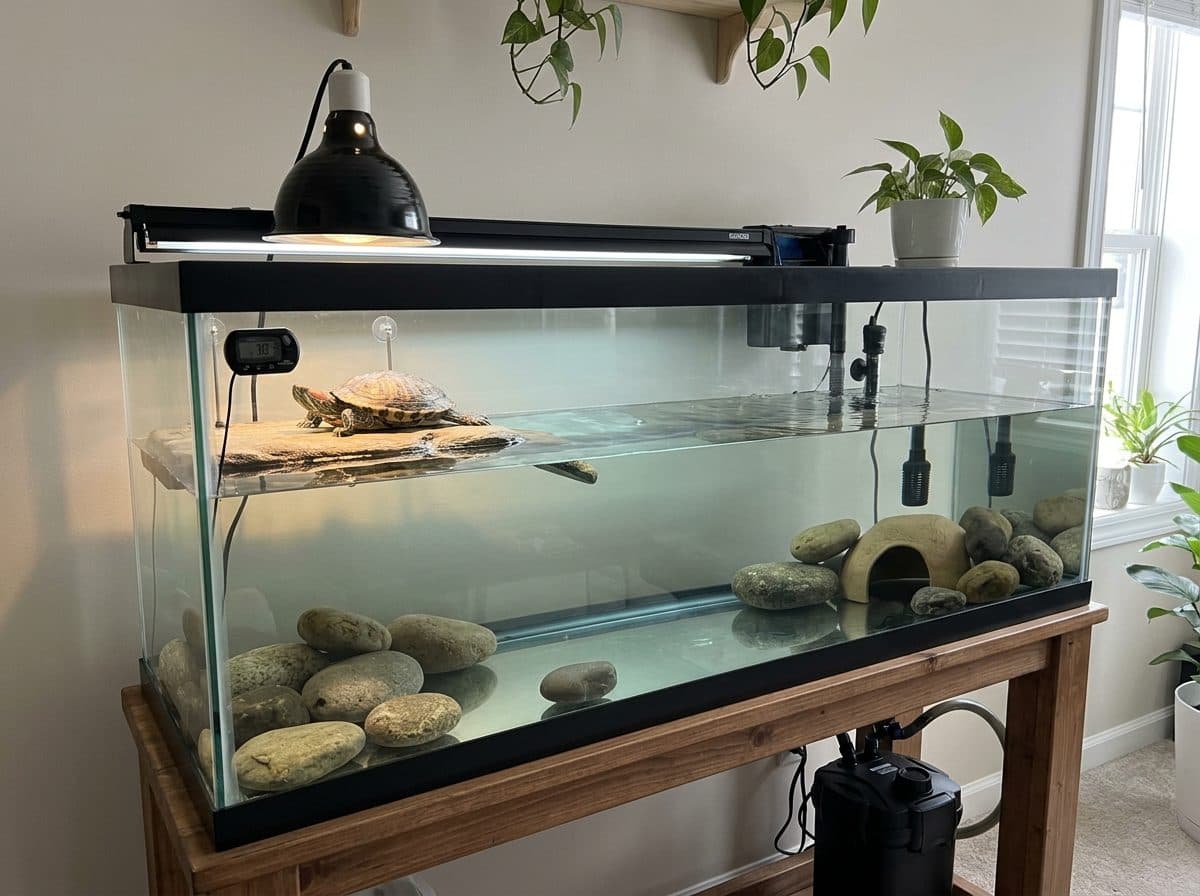
Enclosure size
Adult minimum: 72 × 18 × 18 in (6 × 1.5 × 1.5 ft), 100 gallons. Aquarium, horizontal layout.
Hatchlings can start in a 20 to 40-gallon tank, but they grow rapidly and need larger enclosures within their first year.
Keep individually; housing multiple sliders often leads to severe aggression, severe injuries, and territorial stress.
Adult size: 8-12 in (20-30 cm) shell length. Lifespan: 20–40 years. Difficulty: intermediate. Hands-off: best watched; about 10–20 minutes of care a day.
Temperature & humidity
| Basking surface | 88–95°F |
| Warm side | 80–85°F |
| Cool side | 75–80°F |
| Night | 70–75°F |
| Water | 75–80°F |
Maintain water at 75-80°F for adults (up to 82°F for juveniles) using an aquarium heater with a protective guard. Basking surface temperatures must reach 88-95°F to ensure proper digestion and shell drying.
Lighting & heat
UVB: T5 HO 10-12% linear tube (UVI 3.0-4.0 at the basking spot) spanning 50-75% of the enclosure length over the basking area
Heat: Incandescent or halogen spotlight mounted over the dry basking dock
Day length: 12 on / 12 off hours
Substrate & diet
Good choices: bare bottom; large river rocks (larger than turtle head).
Avoid: small gravel; aquarium sand; crushed walnut; calcium sand.
Diet: Omnivorous. Feed commercial high-quality turtle pellets alongside daily dark leafy greens (dandelion greens, collards) and occasional protein items (earthworms, feeder insects). Juveniles require higher protein ratios, while adults shift primarily to plant matter.
Red-Eared Slider Turtle setup checklist
Everything for a complete adult setup. Essentials are ticked; untick anything you already have.
What a Red-Eared Slider Turtle costs to keep
- Setup (essentials)
- $553–$1,063
- Every year after
- $165–$370
- First year, all in
- $718–$1,433
| Ongoing | How often | Per year |
|---|---|---|
| Pellets, leafy greens, and live proteinProvides essential nutrients through pellets, fresh daily greens, and occasional protein feeders like earthworms. | weekly | $80–$180 |
| Water conditioner and filter mediaDechlorinates tap water during water changes and maintains mechanical and biological filtration efficiency. | monthly | $40–$90 |
| Linear T5 HO UVB lamp replacementUVB output decays over time even if the bulb still emits visible light, risking metabolic bone disease. | every 12 months | $30–$60 |
| Halogen basking spot light bulbsIncandescent and halogen spot bulbs eventually burn out and require replacement to maintain proper basking thermoregulation. | every 3-6 months | $15–$40 |
Typical US prices. Vet care isn't included: budget for a check-up with an exotics vet after you bring your pet home, and keep an emergency fund.
Before your red-eared slider turtle comes home
4-6 weeks before
Cycle the aquarium water completely
Establishes beneficial nitrifying bacteria in the filter to break down toxic ammonia and nitrites from turtle waste.
1 week before
Run heat lamps and UVB lights to test thermal gradients
Ensures the basking temperature and water temperature are accurately measured with a temp gun and thermometer before the turtle arrives.
Day one
Acclimate and place the turtle into the enclosure gently
Transfers the animal safely to its environment without causing excessive temperature shock or physical trauma.
First two weeks
Minimize handling and observe eating habits
Allows the turtle to adjust to its new surroundings and establish a healthy feeding routine without stress.
Within first month
Schedule a initial wellness exam with an exotics veterinarian
Verifies health, checks for intestinal parasites, and establishes a medical baseline with a qualified professional.
Common setup mistakes
- Using small aquarium gravel that turtles can ingest, leading to intestinal impaction.
- Undersizing the filter, resulting in poor water quality, foul odors, and shell infections.
- Failing to provide a proper dry basking dock where the turtle can fully dry its shell and plastron.
- Using compact coil UVB bulbs instead of linear T5 tubes, leading to inadequate UV coverage.
- Housing multiple sliders together, which causes severe territorial stress and physical aggression.
Before you buy: Federal law prohibits selling or distributing turtles under 4 inches in shell length in the US except for strictly educational or scientific purposes; additionally, Red-Eared Sliders are prohibited in Oregon, require a permit in Florida (a Conditional species), and cannot be imported or sold in Vermont, due to their status as an invasive species.
Questions people ask
What size tank does an adult Red-Eared Slider need?
A standard rule of thumb is 10 gallons of water volume per inch of shell length. Adult females reaching 10-12 inches require at least a 100 to 120-gallon aquarium or equivalent stock tank.
What water temperature is right for a Red-Eared Slider?
Water temperatures should be kept between 75°F and 80°F for adults, while juveniles do best slightly warmer at 78-82°F. Always verify with a digital probe thermometer rather than guessing.
What essential equipment do I need for a turtle tank setup?
You need a large aquarium or stock tank, a heavy-duty canister filter, a submersible water heater with a guard, a dry basking dock, a linear T5 UVB fixture, and an overhead heat light.
How much does a full Red-Eared Slider setup cost?
Initial equipment costs for a proper adult setup usually range between $550 and $1,070, driven largely by high-capacity canister filtration, large tanks, and specialized lighting systems.
Sources
The numbers on this page come from these care sheets and references, checked October 2026. How we make these guides.